

Bitumen Technical Properties & Analysis Guide
Technical Analysis and Properties of Bitumen: A Comprehensive Guide for Engineers and Contractors
Bitumen is one of the oldest and most widely used materials in road construction and building waterproofing. Whether naturally occurring or refined from crude oil, bitumen offers unique properties such as water resistance, adhesion, and thermal flexibility. However, to ensure optimal performance in engineering projects, a thorough understanding of bitumen technical specifications and bitumen analysis is essential. This article provides a detailed overview of the chemical and physical characteristics of bitumen, standard testing methods, and key quality control parameters.
1. Chemical Formula of Bitumen
Bitumen is a complex, multi-component material with no single chemical formula. Chemically, it consists mainly of heavy hydrocarbons and compounds containing sulfur, nitrogen, oxygen, and trace metals such as nickel and vanadium.
The general composition of bitumen can be categorized into three major fractions:
- Asphaltenes: High molecular weight, polar molecules that provide stiffness.
- Resins: Polar compounds that act as peptizers, keeping asphaltenes dispersed.
- Maltenes: Include resins, aromatics, and saturated hydrocarbons that contribute to fluidity.
By elemental composition, bitumen typically contains:
- 80–85% carbon
- 8–12% hydrogen
- Minor amounts of sulfur, nitrogen, and oxygen
Due to this variable composition, bitumen is defined by performance properties rather than a fixed chemical structure.
2. Types of Bitumen – Comparison Table
Bitumen is classified based on its source (natural or refined) and production method. Below is a responsive table summarizing common bitumen types and their applications:
| Bitumen Type | Primary Application | Key Characteristics |
|---|---|---|
| Natural Bitumen | Historical and specialty waterproofing | Limited availability, high cost |
| Penetration Grade Bitumen | Road base, surface dressing | Temperature-sensitive, variable viscosity |
| Oxidized (Blown) Bitumen | Roofing, foundation waterproofing | Water-resistant, harder and more brittle |
| Polymer-Modified Bitumen (PMB) | Highways, airport runways | Enhanced elasticity, fatigue resistance |
| Bitumen Emulsion | Prime coat, soil stabilization | Water-based, cold application |
| Cutback Bitumen | Cold climate paving | Diluted with solvent, evaporates after use |
3. Bitumen Analysis and Testing
Bitumen analysis ensures quality, consistency, and suitability for specific engineering applications. Standardized testing methods are defined by international organizations such as:
- ASTM International (American Society for Testing and Materials)
- ISO (International Organization for Standardization)
- DIN (German Institute for Standardization)
- EN (European Norms)
Key laboratory tests include:
- Penetration Test
- Softening Point (Ring & Ball)
- Viscosity Test
- Flash Point Test
- Specific Gravity/Density Test
These tests collectively define the performance grade and behavior of bitumen under varying environmental and mechanical conditions.
4. Viscosity of Bitumen
Viscosity measures bitumen’s resistance to flow and is critical for mixing, compaction, and pumping operations. Viscosity decreases as temperature increases—enabling workability at elevated temperatures.
Viscosity is typically reported in Poise (P) or centiPoise (cP) and is measured using a rotational viscometer (per ASTM D4402).
- Hot Mix Bitumen: Viscosity measured at 135–165°C (275–329°F)
- Emulsified Bitumen: Viscosity measured at ambient temperature
Proper viscosity ensures uniform coating of aggregates and optimal compaction during paving.
5. Specific Gravity of Bitumen
Specific gravity is the ratio of the mass of bitumen to the mass of an equal volume of water at a specified temperature (usually 25°C or 77°F). It is used to convert between mass and volume in mix design and logistics.
The typical specific gravity of bitumen ranges from 1.01 to 1.06 g/cm³.
It is measured using a pycnometer or digital density meter according to ASTM D70 or ASTM D2172.
6. Weight of a Bitumen Barrel
Internationally, one standard barrel equals 159 liters (42 US gallons). Given an average specific gravity of 1.03, the weight of one barrel of neat bitumen is approximately:
159 L × 1.03 kg/L = 164 kg (≈361 lbs)
In many regions, including parts of the Middle East, bitumen is also shipped in 200-liter drums, weighing around 206 kg. Accurate weight calculations are vital for transportation, storage, and cost estimation.

Bitumen Technical Properties
7. Melting Point of Bitumen
Bitumen is an amorphous material and does not have a sharp melting point like crystalline solids. Instead, it gradually softens over a temperature range.
While there’s no true “melting point,” the working temperature for hot bitumen typically ranges from 140°C to 170°C (284°F to 338°F). Exceeding 200°C may cause thermal degradation and release of hazardous fumes.
8. Penetration Grade of Bitumen
The penetration test (ASTM D5 / EN 1426) measures bitumen hardness by determining how far a standard needle (100 g) penetrates a sample in 5 seconds at 25°C.
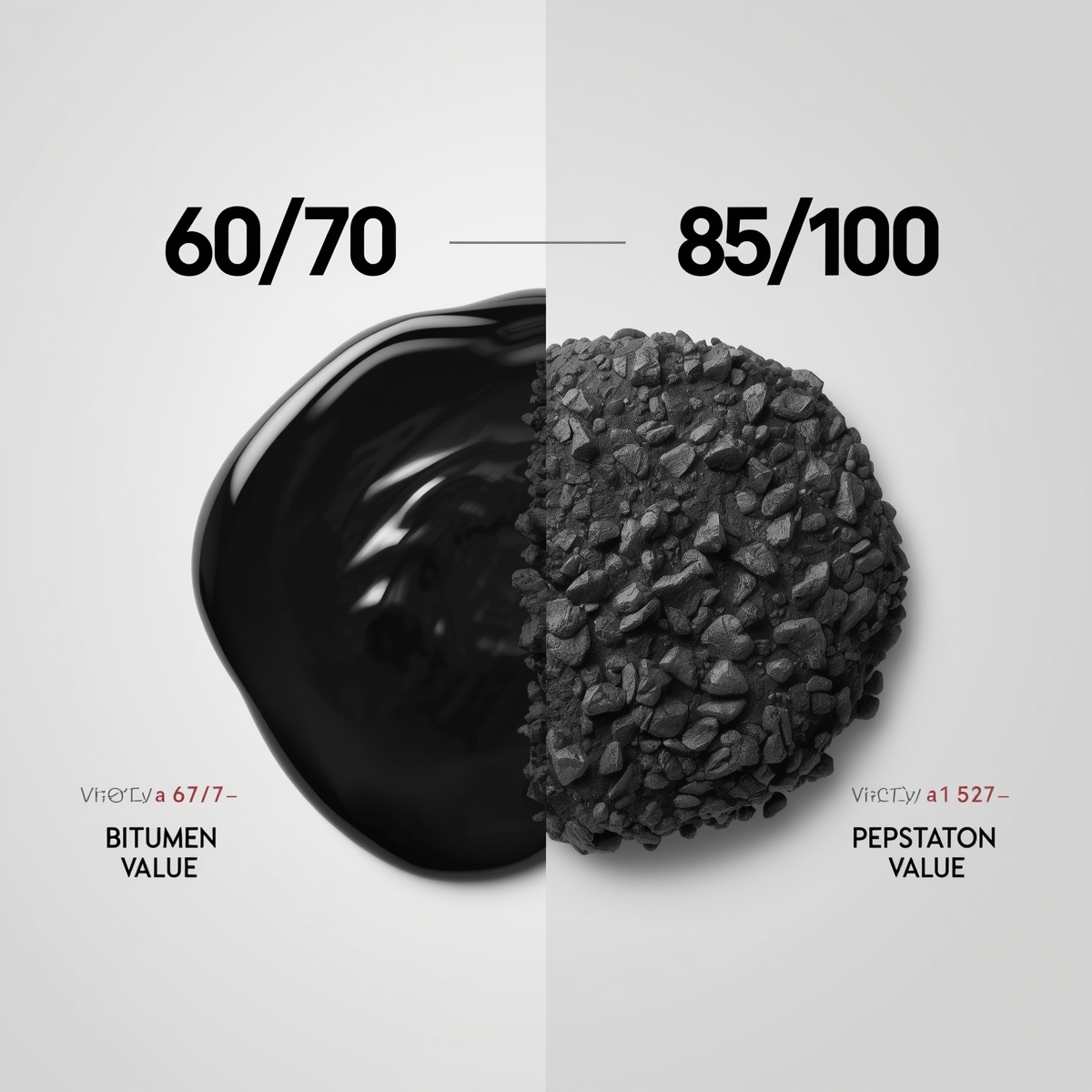
Results are reported in 0.1 mm units (e.g., 60/70 means 60–70 dmm penetration).
- High penetration (80–100): Softer, suitable for cold climates
- Low penetration (40–60): Harder, ideal for hot climates
This classification remains widely used in many countries for specifying bitumen grades.
9. Boiling Point of Bitumen
Bitumen is a non-volatile residue of crude oil distillation and does not have a defined boiling point. At temperatures above 300°C (572°F), bitumen undergoes thermal cracking, decomposing into lighter fractions and emitting toxic gases like hydrogen sulfide (H₂S).
Therefore, bitumen should never be heated beyond 200°C (392°F) during handling or storage.
10. Softening Point of Bitumen
The softening point indicates the temperature at which bitumen begins to soften significantly under load. It is measured using the Ring and Ball method (ASTM D36 / ISO 4625).
In this test, a steel ball is placed on a bitumen sample in a brass ring, and the assembly is heated in a glycerin or water bath. The temperature at which the bitumen softens enough for the ball to fall a specified distance is recorded as the softening point.
- Penetration grade bitumen: 40–55°C
- Oxidized bitumen: 80–100°C
A higher softening point indicates better resistance to rutting in hot weather.
Conclusion
Understanding the technical analysis and properties of bitumen is crucial for selecting the right material for road construction, waterproofing, and industrial applications. Parameters such as penetration grade, softening point, viscosity, and specific gravity directly influence performance, durability, and cost-efficiency. Engineers and contractors must rely on standardized testing and regional climate data to choose the optimal bitumen type—ensuring long-lasting, high-quality infrastructure.