
Petroleum Bitumen vs. Natural Bitumen — Key Differences and Applications
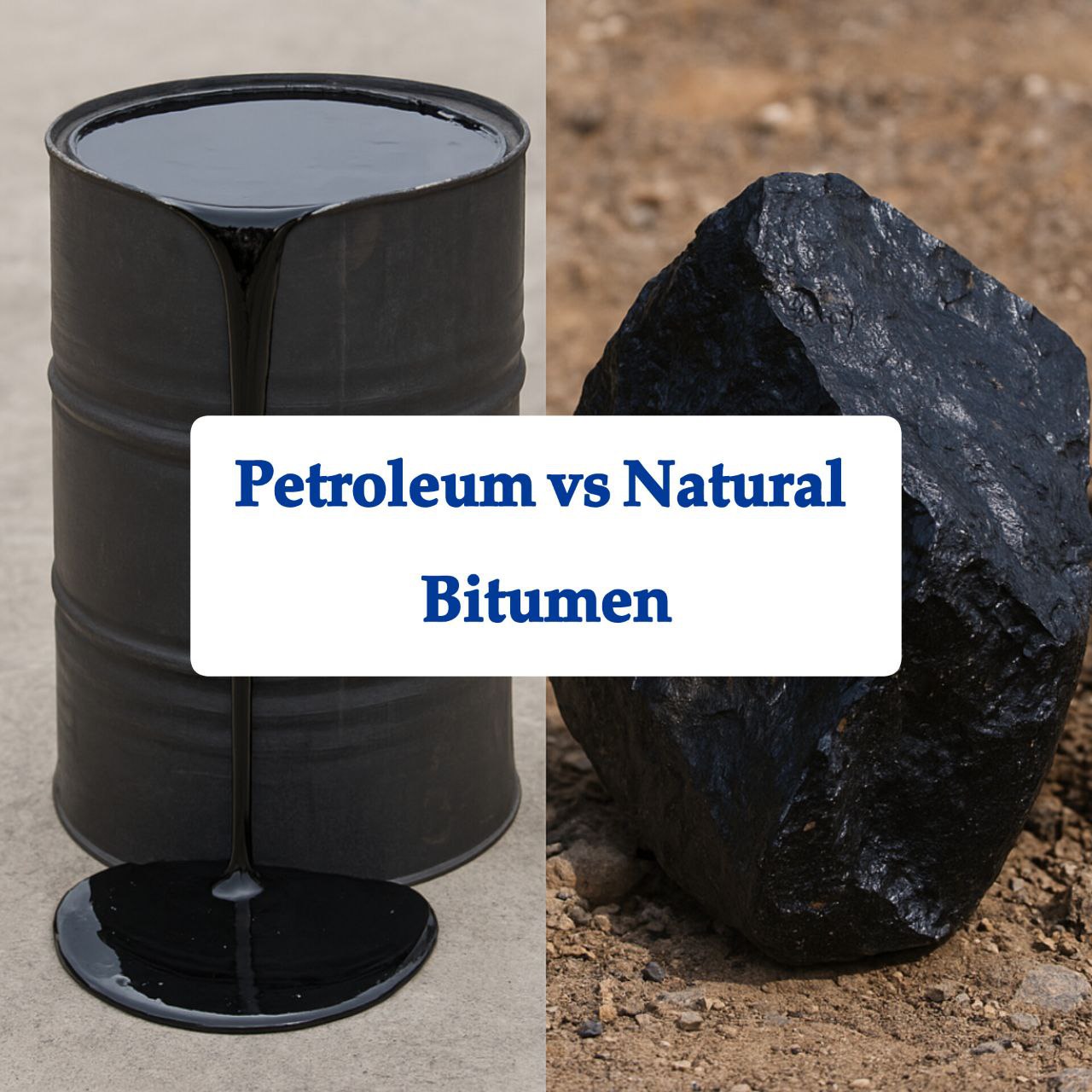
Petroleum bitumen and natural bitumen are the two main types of bitumen, each with its own characteristics, advantages, and applications.
In this article from Iran Bitumen, we examine the differences between petroleum and natural bitumen and their uses in various industries.
—
Introduction
Bitumen is one of the most important materials used in construction, road paving, and waterproofing industries.
This black, viscous substance is generally divided into two major categories: petroleum bitumen and natural bitumen.
Understanding the difference between the two helps engineers and companies choose the most suitable type for their industrial and infrastructure projects.
—
What Is Petroleum Bitumen?
Petroleum bitumen is produced through the refining (distillation) of crude oil.
During this process, lighter hydrocarbons such as gasoline and diesel are separated, leaving behind a heavy, sticky residue — bitumen.
Key Features of Petroleum Bitumen:
Black and glossy appearance
High adhesive and waterproof properties
Adjustable hardness depending on grade (soft or hard bitumen)
Mass production in refineries with consistent quality
Main Applications of Petroleum Bitumen:
Road construction and asphalt paving
Building insulation (roofing and waterproof membranes)
Coating pipelines, tanks, and oil & gas facilities
—
What Is Natural Bitumen?
Natural bitumen, also known as mineral bitumen or gilsonite, is obtained from natural deposits within the earth.
It forms over millions of years as crude oil seeps through rock layers and undergoes natural oxidation and solidification.
Natural bitumen is usually found in solid or semi-solid form in bitumen mines.
Key Features of Natural Bitumen:
Higher purity compared to petroleum bitumen
Greater durability and resistance to weathering and chemicals
Requires mining and refining before use
Limited production, depending on natural reserves (notably found in Ilam Province, Iran)
Main Applications of Natural Bitumen:
Advanced waterproofing and coating industries
Production of special chemical compounds
Asphalt additive to improve resistance and longevity
—
Main Differences Between Petroleum and Natural Bitumen
Feature Petroleum Bitumen Natural Bitumen
Source Refined from crude oil Extracted from natural deposits
Purity Lower purity Higher purity
Durability Moderate Very high
Production Cost Cost-effective and economical Higher cost due to limited reserves
Main Applications Road construction, insulation Specialized industrial uses and additives
Production Volume Mass-produced globally Limited and region-specific
—
Which Type of Bitumen Is Better?
The choice between petroleum and natural bitumen depends on project requirements:
For large-scale road construction and civil projects, petroleum bitumen is preferred due to its affordability, consistency, and wide availability.
For high-durability or specialized industrial applications, natural bitumen is the better choice, thanks to its purity and longevity.
—
Conclusion
Both petroleum bitumen and natural bitumen play vital roles across industries.
Petroleum bitumen dominates the global market because of its mass production and cost efficiency, while natural bitumen is valued for its purity, durability, and specialized uses.
Ultimately, the selection depends on the technical needs and budget of each project.